 Thezis
How to find peer-reviewed sources for a research paper

Finding a peer-reviewed article is not the same as finding a PDF that looks academic. Start in a database suited to your field, search the concepts in your question, verify the article type and review status, and record why the source belongs in your paper.
Start with the question, not a random keyword
Break your research question into two or three concepts, then list synonyms for each. Library databases often use subject headings as well as the words in a title or abstract. The University of Sydney recommends combining keyword variants with database subject terms instead of assuming every author uses the same vocabulary. University of Sydney: Using academic databases
| Question concept | Possible terms | Search move |
|---|---|---|
| Population | first-year students; undergraduates | Join synonyms with OR. |
| Phenomenon | academic feedback; written feedback | Search the phrase and its variants. |
| Outcome | revision; uptake; transfer | Test one outcome at a time if results are thin. |
(undergraduate OR college student*) AND (written feedback OR instructor feedback) AND (revision OR transfer)
This is a search starting point, not a universal formula. Database syntax, truncation, and subject headings vary. Save the exact query and date so you can explain how the results were found.
Use a database that matches the field
Your library’s subject databases usually give you better filters and vocabulary than a general web search. Depending on the field, that may mean ERIC, PsycINFO, PubMed, JSTOR, Scopus, Web of Science, or another database your library provides. A search engine can help you discover terminology, but it should not replace the database and library guidance for your assignment. University of Nevada, Reno: Finding scholarly articles
- Use the peer-reviewed or refereed filter when the database provides one.
- Use the publication-date filter only when your assignment requires a date boundary.
- Open the record and inspect the article type; editorials, reviews, and book notices may appear in scholarly journals without being research articles.
- Ask your librarian when the assignment’s source rule is unclear or the database cannot verify it.
Peer review is a useful publication signal, not a guarantee that an article answers your question or supports your claim. The University of Nevada notes that a peer-reviewed journal can contain items such as editorials or book reviews that were not reviewed in the same way as research articles. University of Nevada, Reno: Peer-review cautions
Verify the source before you keep it
| Check | Evidence to record | Do not assume |
|---|---|---|
| Identity | Title, authors, journal, year, DOI or stable record | A search-result title is the complete citation. |
| Eligibility | Peer-review status and article type | Every item in a peer-reviewed journal is a research article. |
| Relevance | Population, concept, outcome, and scope | A shared keyword means the study answers your question. |
| Usability | Full text or the exact section you can inspect | An abstract contains every limitation you need. |
Illinois guidance recommends checking authorship, disciplinary purpose, documentation, and whether the source is actually peer reviewed. Keep those checks separate from the question of whether the source is useful for your paper; a credible article can still be the wrong source for your claim. University of Illinois: Determine if a source is scholarly
Move selected sources into a writing plan
Claim it may support: Specific feedback can help students revise the current assignment. Evidence location: Results section, comparison of draft scores. Boundary: The study does not show whether the skill transfers to a later assignment. Role in paper: Evidence for the immediate-revision section.
The record preserves a possible use and its limit. Replace the fictional example with notes from the source you actually read.
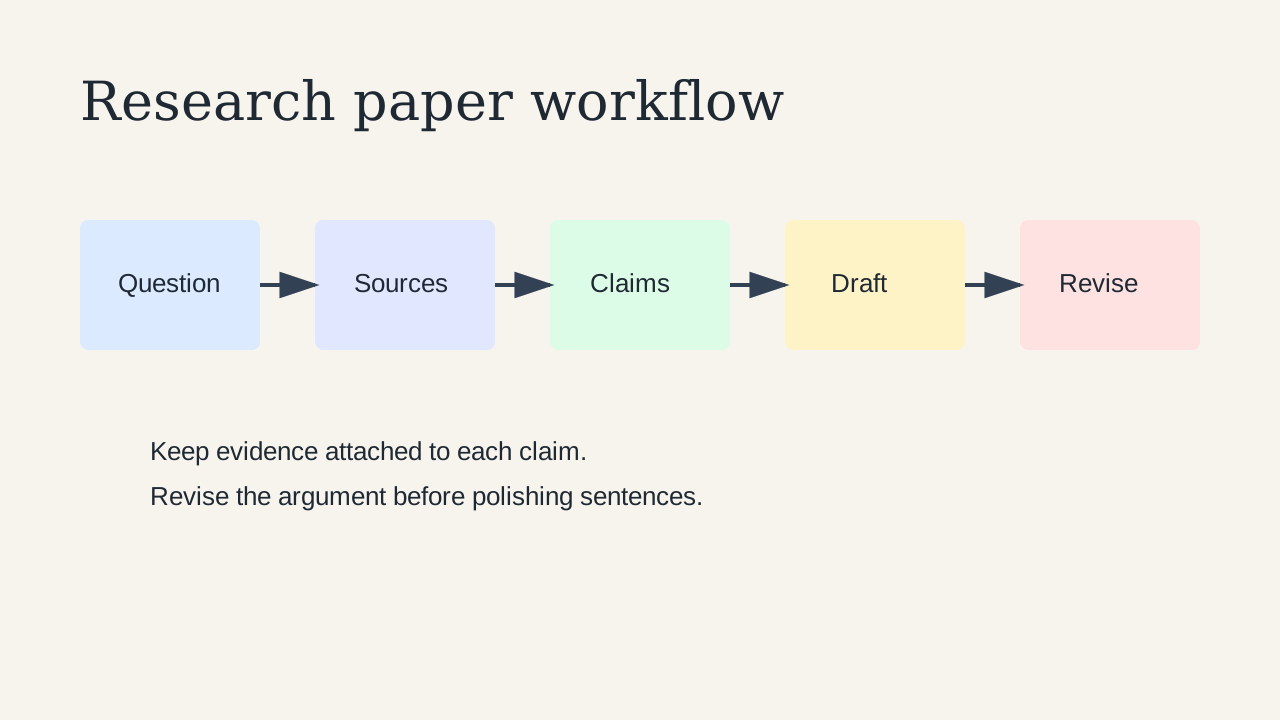
Do not collect articles without deciding what each one contributes. A small set of verified sources with clear roles is more useful for drafting than a large folder of unread PDFs. Keep the source record beside the outline so the transition from search to writing remains visible. Organize literature review notes