 Thezis
How to write a methodology chapter: explain and justify your methods

A methodology chapter is not a diary of everything that happened. It is the evidence a reader needs to judge whether your design can support the claims you later make.
Map the chain from question to inference
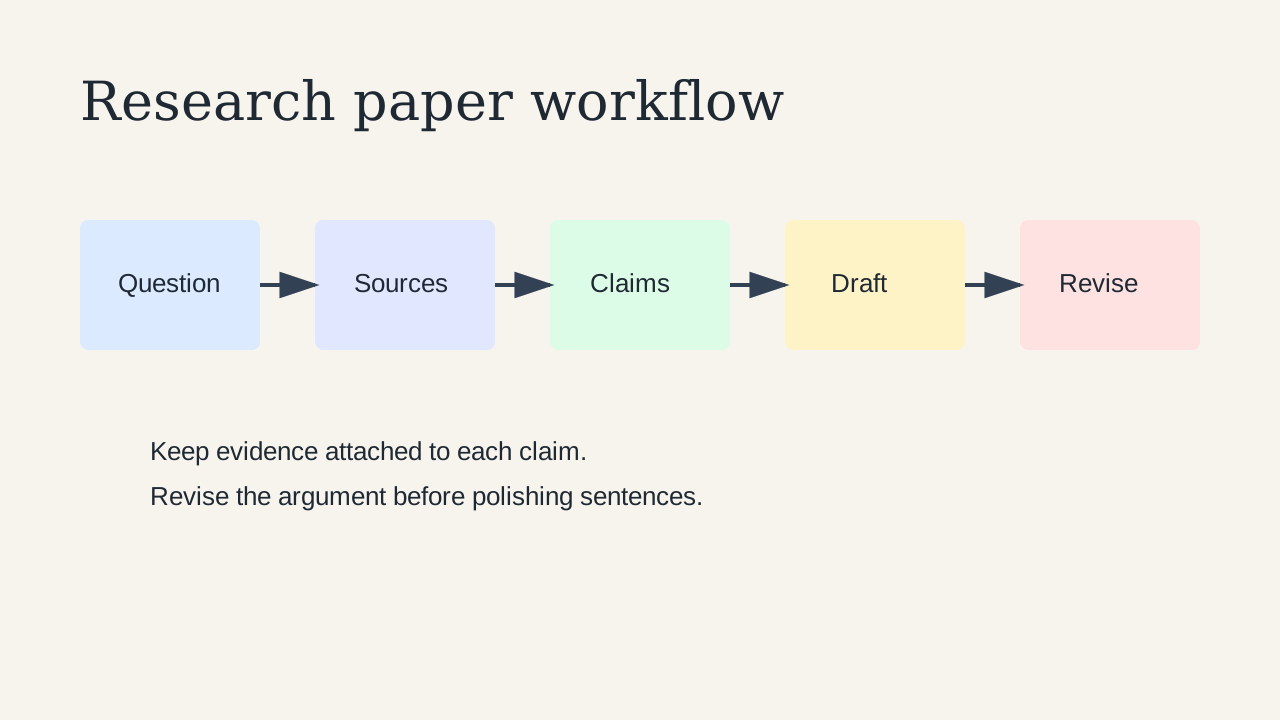
- Question: what exactly are you trying to understand, compare, estimate, or explain?
- Design: why is an experiment, survey, archive, interview, observation, or mixed approach suitable?
- Evidence: who or what was included, and how were data collected?
- Analysis: what did you do with the evidence?
- Boundary: which conclusions would go beyond this design?
Justify choices at the point readers need them
I used semi-structured interviews because the research question concerns how students describe decisions about study space; a fixed-response survey would not by itself reveal the reasoning behind those decisions. Interviews were audio-recorded with consent, transcribed, and coded for recurring constraints and exceptions.
The example is fictional. Notice that it gives a reason for the method, then enough procedural detail to understand the evidence. It does not claim that interviews measure prevalence.
Avoid writing that treats a standard method as self-justifying. Name the methodological tradeoff. A small qualitative sample may provide depth but cannot establish how common a pattern is; a survey may estimate a pattern while missing how participants interpret it. USC Libraries: Organizing your social sciences research paper
Audit nouns, verbs, and limits
| Draft says | Check | Possible repair |
|---|---|---|
| Participants were representative | How were they sampled? | Describe the recruitment; avoid representativeness unless the design supports it. |
| The interviews proved | Can interviews prove this causal claim? | Say participants described or reported. |
| The data were unbiased | Which biases remain plausible? | Name the safeguards and the remaining limitation. |