 Thezis
How to Write a Research Paper: A Practical Guide from First Question to Final Draft
A research paper is not a long report about everything you read. It is an answer to a focused question, supported by evidence, organized for a reader who needs to understand how you reached that answer.
Start with a question narrow enough to answer
Before collecting dozens of sources, write the question your paper will answer. A useful question names the topic, the angle, and the kind of evidence you need. Harvard's writing guidance emphasizes analytical questions because they give the paper a job beyond summarizing a topic. Harvard Writing Center
| Too broad | More workable |
|---|---|
| Social media and students | How does short-form video affect first-year students' study routines? |
| Climate change policy | Why did one city adopt a heat-action plan earlier than comparable cities? |
| AI in education | What risks do writing centers identify when students use AI for revision? |
Read sources for usable claims, not just highlights
For each source, record the exact claim you might use, where it appears, and what the source cannot prove. Students often get stuck because their notes say 'good article' or 'supports my point' without the page, method, or limitation needed for a paragraph.
- Write a one-sentence summary of the source's relevant finding.
- Record page, section, table, or figure locators immediately.
- Separate the author's claim from your interpretation.
- Tag the source by the section or question it could support.
Purdue OWL's research and citation resources are useful here because citation work is not a final formatting chore. It is how you keep claims traceable while the draft changes. Purdue OWL
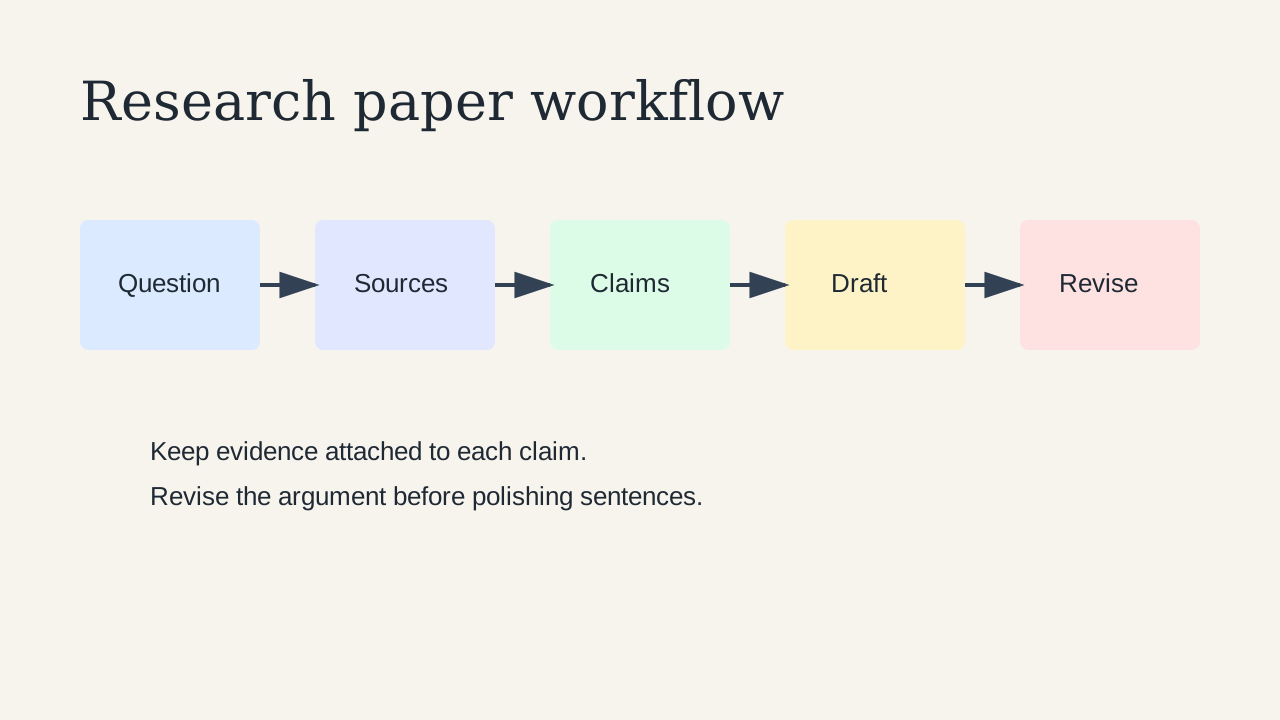
Draft from an argument map, then revise in passes
Question: Why do students abandon source notes? Claim: Notes fail when they summarize whole papers instead of capturing evidence for a section question. Evidence: Source A on reading strategies; Source B on writing transfer; Source C on student revision behavior. Limit: These sources do not measure Thezis users directly.
This is enough to begin a paragraph because the claim, evidence, and limitation are visible before sentence polishing begins.
Revise first for argument, then for paragraph order, then for sentences. If you polish too early, you may protect a beautiful paragraph that no longer answers the question.