 Thezis
Research proposal format: template with word counts for every section

Here is the format first. Copy the template, delete the sections your brief doesn't ask for, and answer the questions under each heading. The explanations come after, for when you need them.
The template
Title A specific title that names the topic, population and method. 1. Introduction and problem What situation or debate does this study start from? What exactly is not known? Why does that matter, and to whom? 2. Aims and research questions One main question in a single sentence. Two or three sub-questions only if each needs its own evidence. 3. Literature review Group sources by theme. Where do studies agree, disagree, and stop? End with the gap your question fills. 4. Methodology Why this design suits the question. Who or what you will study, how you will reach them, how you will analyze the data. 5. Ethics and data management Approvals needed and when. Consent, anonymity, storage. 6. Timeline Milestones by week or month, each with an output. 7. Expected contribution What the answer could add, kept to the scale of your method. References
Grant applications usually add a budget and an impact section. A PhD proposal usually adds a theoretical framework after the literature review.
Want this filled in for your level, method and word limit? The research proposal template tool builds it with prompts and word counts. Research proposal template
Which sections your level needs
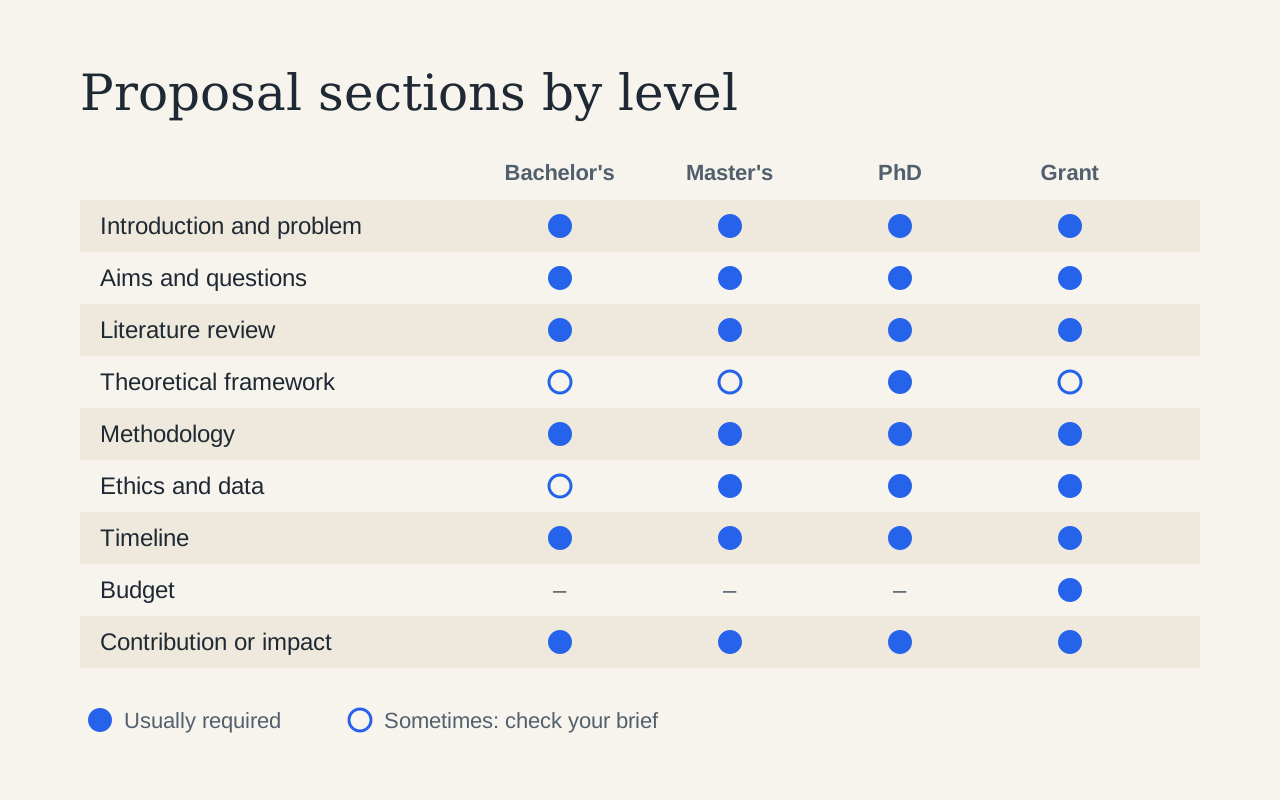
University guidance commonly groups a proposal around an introduction, a review of relevant research, the method, and the expected contribution. The extra sections are where levels differ. Kennesaw State University Writing Center
Word counts for every section
| Section | Share | 1,500 words | 3,000 words | 5,000 words |
|---|---|---|---|---|
| Introduction and problem | 15% | 225 | 450 | 750 |
| Aims and research questions | 5% | 75 | 150 | 250 |
| Literature review | 30% | 450 | 900 | 1,500 |
| Methodology | 25% | 375 | 750 | 1,250 |
| Ethics and data management | 5% | 75 | 150 | 250 |
| Timeline and feasibility | 10% | 150 | 300 | 500 |
| Expected contribution | 10% | 150 | 300 | 500 |
The biggest risk is a literature review that eats the method. Readers approve a plan they can picture, so if you must cut, cut background, not procedure.
Format rules that cost marks
| Rule | Why | Fix |
|---|---|---|
| Future tense for planned work | Nothing has happened yet. | "I will interview", not "I interviewed". |
| One citation style throughout | Mixed styles look careless. | Use the style your brief names, usually APA 7. |
| Numbered headings if the brief numbers them | Markers follow the rubric's order. | Mirror the rubric's headings exactly. |
| A timeline as a table, not a paragraph | Dates in prose are hard to check. | One row per milestone, with its output. |
| Claims sized to the method | Interviews can't prove prevalence. | Say "explore" or "describe" for qualitative designs. |
An example timeline table
| Month | Milestone | Output |
|---|---|---|
| 1 | Ethics approval and recruitment plan | Approved application |
| 2 | Recruit and run first interviews | 8 transcripts |
| 3 | Finish interviews and start coding | Code book, first themes |
| 4 | Analysis and supervisor check | Themes memo |
| 5 | Draft findings and discussion | Chapter drafts |
| 6 | Revise and submit | Final thesis |