 Thezis
Why Citation Tools Get Author Names Wrong, and How We Fixed It
A draft in Thezis cited a Zoom report as “(New, 2026).” Nobody named New wrote it. The page has a “What’s New” label, and a search index had mistaken that label for a byline. When we added the same link by hand, Thezis found no author at all. One link, two different answers, and neither looked broken unless you checked the original page. This post explains why that happens, what we measured, and what we changed.
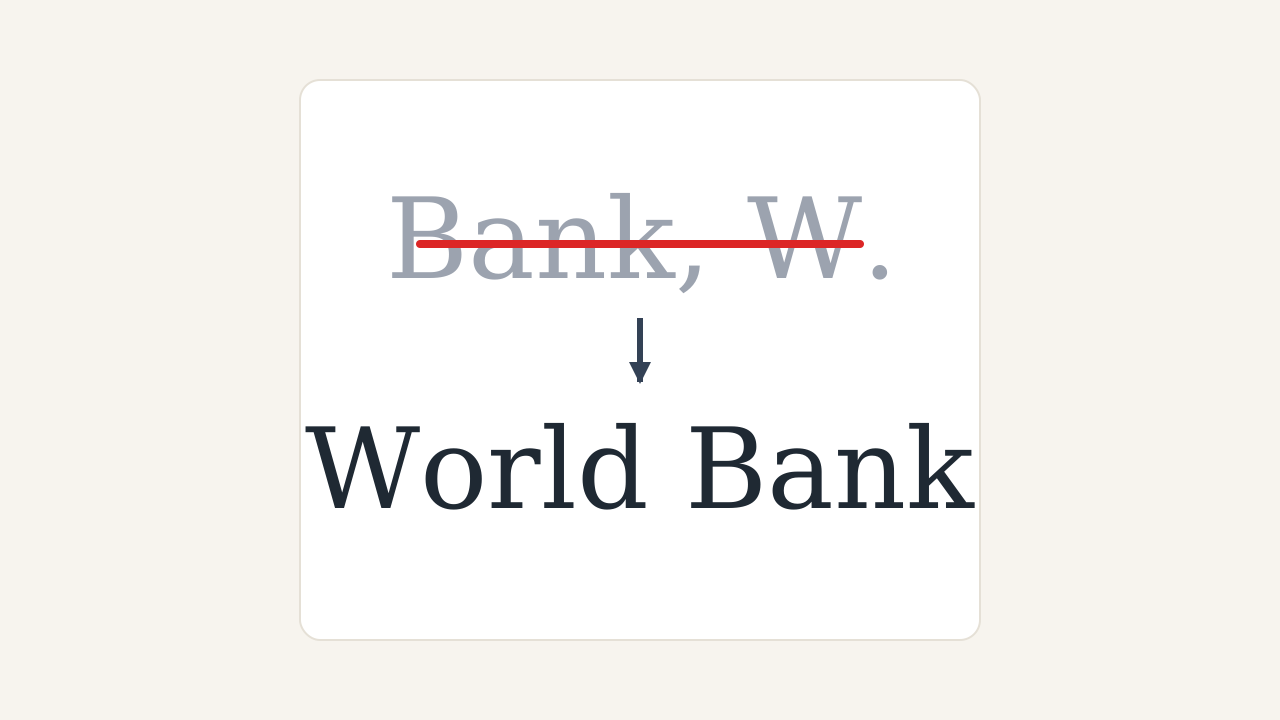
One link, two different authors
Thezis can add a source in two ways. When the chat researches a topic, it uses a search index that stores its own guess at each page’s author. When you paste a link yourself, Thezis reads the page and the official records behind it. The two paths disagreed, and the chat trusted a guess.
New, W. (2026). The state of solopreneurship in 2026. Zoom.
APA puts the author first. A wrong author does not just look odd: it changes where the source sits in the list and how every in-text citation reads.
The first fix was simple: read the page itself, the same way a pasted link is read, and use the search index’s guess only when the page names no one. Then came the harder question: how often were other authors wrong, and why?
Patching one word at a time did not work
We first ran 40 research questions through the chat’s source search and checked 198 results against the pages they came from. Most of the search index’s author guesses were right. The wrong ones were things like “What’s New,” “Admin,” a username such as “aby24,” and a sentence fragment, “how to fill it out.”
A filter for those patterns looked like a fix. A larger test later showed it had deleted two real authors, including “Shirmatova Durdona Sherzodbek qizi,” an Uzbek name that ends in a lowercase word. A rule written for messy web pages had been applied to careful official records. That was the signal to stop patching and measure the whole problem.
We tested 972 sources
We sampled sources the way students actually use them, then ran each one through the same import Thezis uses and compared the result with the official record from Crossref or DataCite, the registries that issue DOIs.
| Group | Sources | What it included |
|---|---|---|
| Scholarly works | 692 | 12 kinds of work (articles, chapters, books, reports, theses, datasets, preprints, standards), authors from 15 countries, 12 publishers and registries, conference papers, and teams of 40+ authors |
| Web pages | 280 | 19 kinds of site: news, blogs, government, NGO reports, think tanks, magazines, medical sites, encyclopedias, university news, and non-English pages |
| Total | 972 | 3,286 authors across the sources that could be read |
What we found
People’s names were mostly fine. The failures came from one design gap: when a source gave an author as a single piece of text, the import guessed what it was from commas and the word “and.” That works for “Jane Doe and John Smith.” It fails for an organization.
| Problem | How often | Example |
|---|---|---|
| Organization split into a fake person | 38 of 64 organizations sent as one name (59%) | World Bank became “Bank, W.” |
| Address turned into authors | 11 sources | Oak Ridge National Lab. plus “TN (United States)” |
| Name kept in capitals | 37 scholarly sources (about 5%) | “WAKITA, M.” |
| Same author listed twice | 9 sources | A registry record that repeats a name |
| Page blocked automated reading | 78 of 280 web pages (28%) | Some large publishers and magazines |
The last row matters because when a page cannot be read, the search index’s guess is the only author available. Those guesses were right about five times in six, so throwing them away would have lost more correct authors than it saved.
The fix: decide what each name is before formatting it
Instead of adding another rule for every new mistake, Thezis now asks one question about every author before it formats anything: is this a person, an organization, or not a name at all?
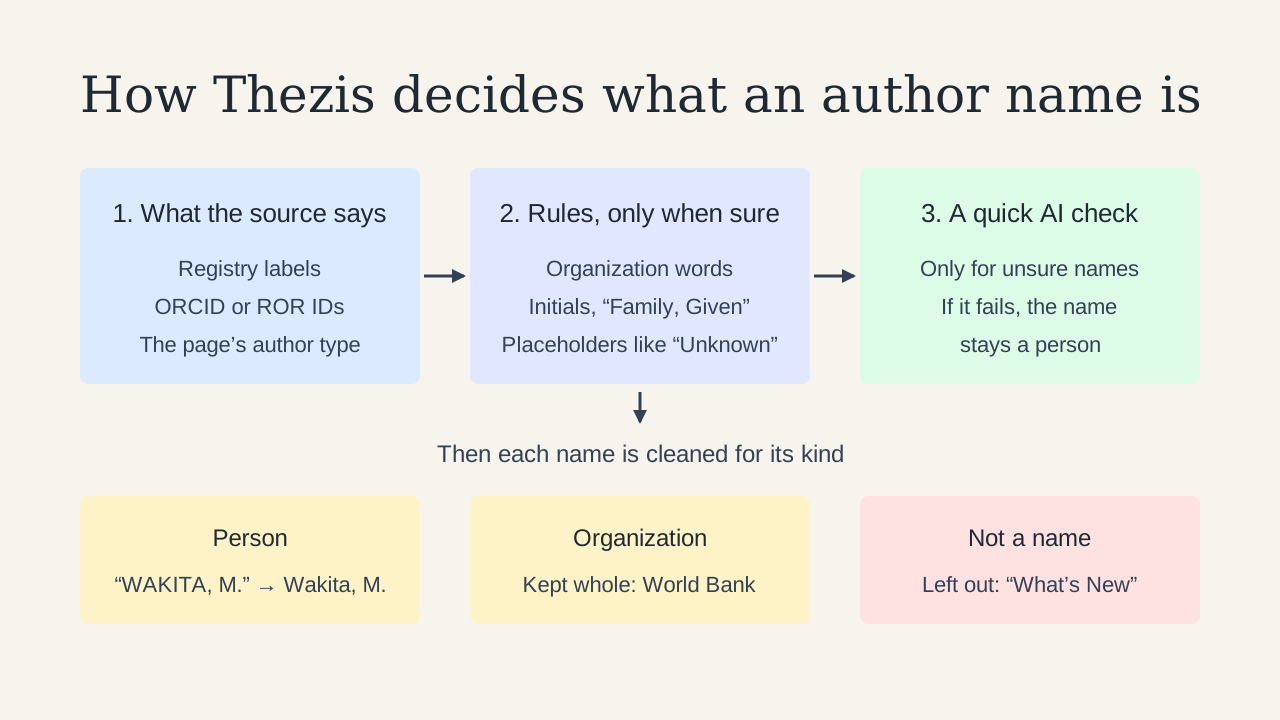
- First, use what the source already says. Official records from the registries that issue DOIs often label an author as a person or an organization, or attach an ORCID (a researcher ID) or a ROR ID (an organization ID). Many web pages mark their author as a Person or an Organization in hidden page data.
- Next, apply rules only when they are sure: organization words in several languages, initials, a “Family, Given” name, or a placeholder such as “Unknown.”
- Finally, ask a quick AI check about the few names that are still unsure. If the check fails, the name stays a person, so adding a source never breaks.
Cleaning then follows the answer. Organizations stay whole and lose any address. People’s names are put in the right order and taken out of capitals, without touching initials or acronyms such as CDC. Labels and placeholders are left out, and a source with no author is cited by its title, as APA recommends. APA Style: Missing reference information
How we checked the fix
We tested the new approach before it reached the app, then tested the app itself.
| Check | Result |
|---|---|
| 2,955 names whose answer was already known (people and organizations from DataCite, ROR, OpenAlex, and Crossref) | Organizations recognized 99.3% of the time, up from 72–86%; people stayed about 99% |
| The same 972 sources, old method against new | 105 results changed; we read every one, and 104 were clear improvements |
| The app’s code against the tested version | Identical results on all 884 sources that could be imported |
| Real imports in the running app | The cases from this post came out right, as the screenshots show |
Most of the remaining misses in the 2,955-name test were labels that were wrong in the source data itself, such as a physics collaboration filed as a person. The genuinely hard cases are single words such as “Girish,” which could be a person or a company.
Testing also caught our own mistakes before they shipped. We had assumed one registry never lists people as a single name; it sometimes does. A first version of the capitals fix turned the initials “MA” into “Ma.” And the app briefly turned a saved “World Bank” back into “Bank, W.” when reading it again. Each was found by checking real output, not by reading code.
Before and after
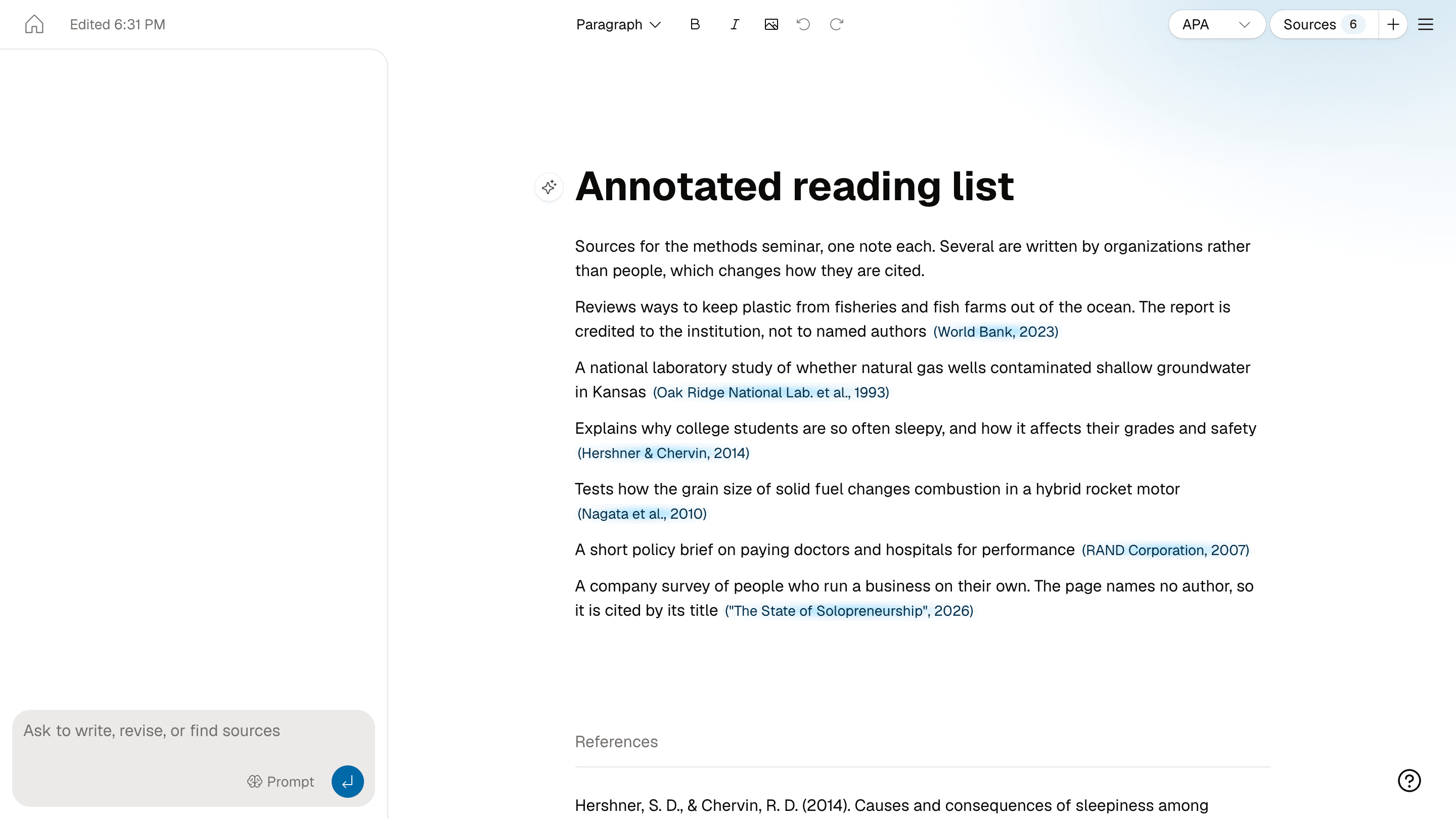
| Source | Before | After |
|---|---|---|
| A World Bank report | Bank, W. | World Bank |
| A national laboratory report | “Lab., O. R. N.” with “TN (United States)” as an extra author | Oak Ridge National Lab. |
| A sleep study in PubMed Central | SD, H., & RD, C. | Hershner, S. D., & Chervin, R. D. |
| A Japanese engineering paper | NAGATA, H., HASHIBA, K., … | Nagata, H., Hashiba, K., … |
| A herbarium dataset | Edinburgh, R. B. G. | Royal Botanic Garden Edinburgh |
| A company blog report | New, W. | Cited by its title |
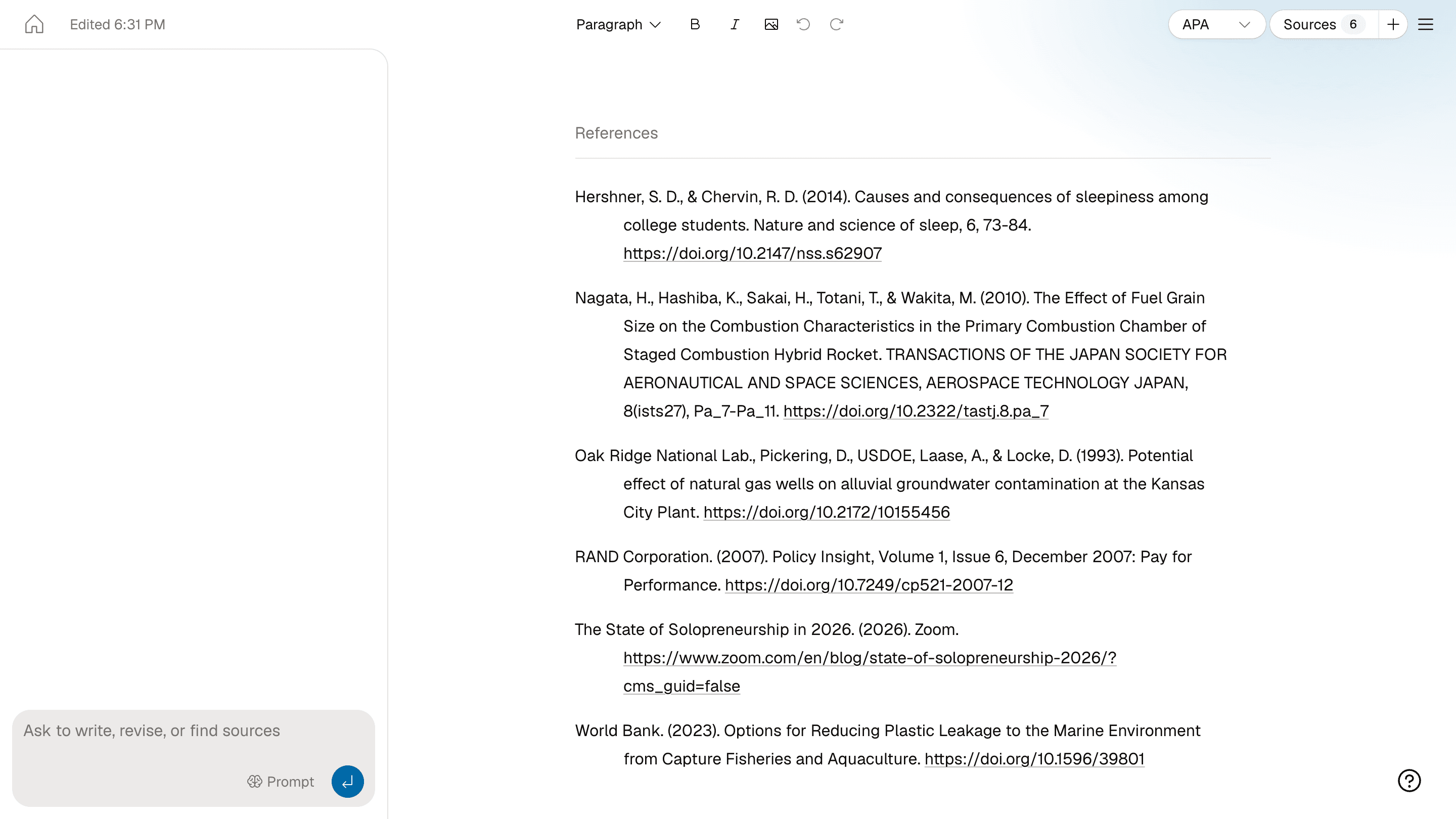
Organizations as authors are normal in academic writing. APA calls them group authors and cites them by their full name. APA Style: Group authors
What is still not perfect
- Citations already in your documents keep the authors they had when you added them. The fix applies to sources you add from now on.
- Some registries store wrong labels or incomplete names. Thezis can tidy a name, but it cannot invent information that the record does not contain.
- In chat research, pages that block automated reading still depend on the search index’s guess, which is cleaned but not checked against the page.
- Single-word names remain ambiguous. When in doubt, Thezis keeps them as written rather than guessing.
What to check in any citation tool
Whatever tool you use, a two-minute check of the reference list catches most of these problems before your marker does.
- An organization written like a person: “Bank, W.” or “Edinburgh, R. B. G.”
- A surname made of initials, such as “SD, H.,” or a name in capitals
- Website labels as authors: “Admin,” “Staff,” “What’s New,” or a username
- A place in the author list, such as a city or “(United States)”
- The same person listed twice
- A source with no author that starts with something other than its title
When something looks wrong, open the original page or the DOI record and copy the author exactly as it is credited there.