 Thezis
Write my annotated bibliography: finish 10 sources in one evening
Ten annotations by tomorrow is about three hours of focused work, not a lost weekend. The trick is to stop rereading: triage the sources first, then give each survivor the same 15-minute loop. This guide won't write the bibliography for you, but it will get you to a finished one tonight.
Know what a finished entry looks like
Most assignments want three things under each reference: what the source found, how much you trust it, and how you'll use it. Some only want the summary. Check your brief once, now, so you don't write evaluations nobody asked for.
Okafor, L. (2024). Library opening hours and evening study among part-time students. Studies in Higher Education Practice, 9(1), 15–29. This survey of part-time students at two universities compares when students say they study with when libraries are open. Most respondents reported studying in the evening, when one of the two libraries was closed. The comparison is clear, but students who already used the library were easiest to recruit. I will use it to show that opening hours, not only seat numbers, shape access.
Summary, evaluation and use, in about 90 words. Three examples of each annotation type are in the companion guide.
Need the difference between descriptive, evaluative and critical annotations first? Annotated bibliography: 3 examples
Triage all ten sources in 20 minutes
Read every abstract before you annotate anything. Sorting first stops you from spending 15 minutes on a source you'll drop.
| Pile | Test | What to do |
|---|---|---|
| Use | It answers part of your question with a method you can name. | Annotate first, while you're fresh. |
| Maybe | Relevant topic, but you can't tell the method or finding. | Annotate last. Skim the method section first. |
| Drop | Different population, opinion piece, or only shares a keyword. | Replace it now. Searching later breaks your rhythm. |
Annotate each source in a 15-minute loop
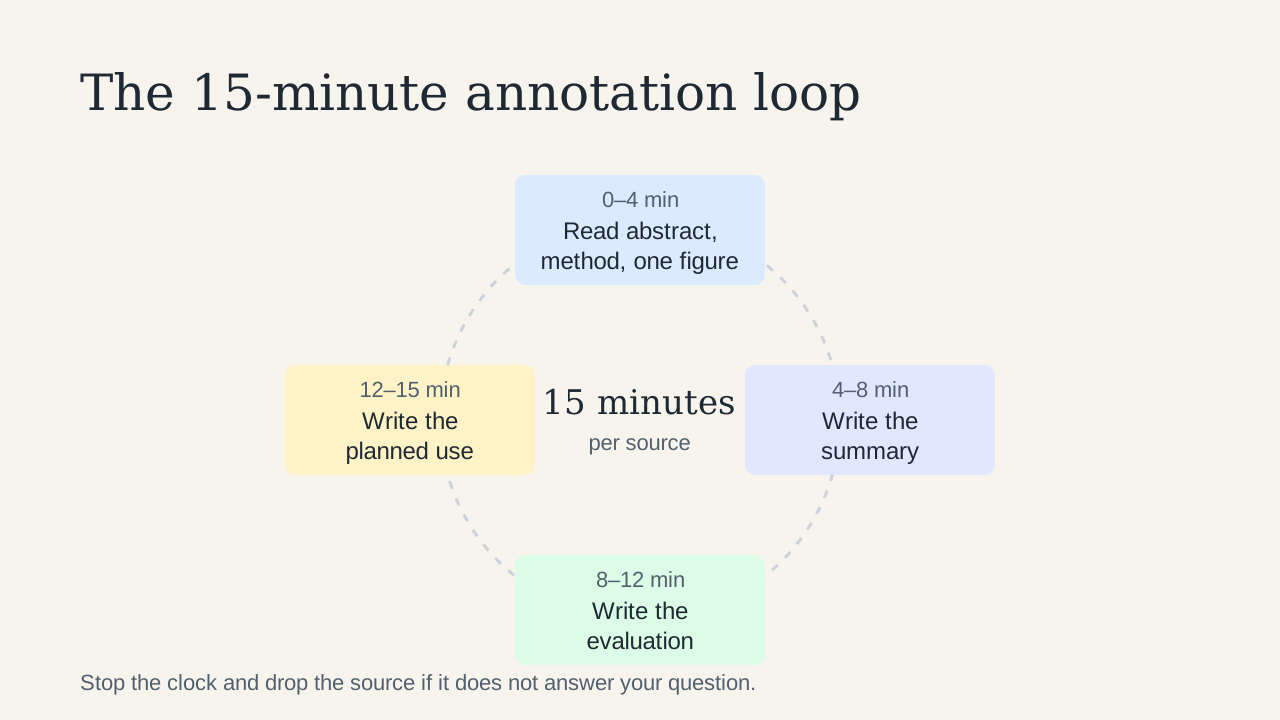
| Minutes | Do | Answer |
|---|---|---|
| 0–4 | Read the abstract, the method section and one table or figure. | Who or what was studied, how, and what was found? |
| 4–8 | Write the summary. | Question, method and main finding, in two or three sentences. |
| 8–12 | Write the evaluation. | One strength and one limit, both about the method. |
| 12–15 | Write the use. | Which section or claim of your paper will this support? |
If a step runs over, write down what's missing and move on. Ten imperfect annotations you can fix tomorrow beat six polished ones and a blank page.
One source, annotated against the clock
0:00 Abstract: interviews with 18 commuter students at one university about when they travel to campus. 2:30 Method: semi-structured interviews, coded for themes. No survey. 4:00 Summary drafted: "This interview study asks how commuter undergraduates decide when to study on campus..." 8:00 Evaluation: rich accounts of decisions; one campus and a small sample, so it can't say how common this is. 12:00 Use: supports my point that uncertainty about space, not distance alone, keeps commuters away. 14:30 Flag: check the exact wording of the main theme on p. 51 before quoting.
The last line matters. Write down the one thing to verify instead of verifying it now.
Which AI help your instructor is likely to accept
Policies differ by course, so your syllabus wins. Annotations are also the easiest work for an instructor to check: they can open the source and compare. A drafted evaluation that names a limitation the paper doesn't have is easy to spot.
| Usually fine | Ask first | Usually misconduct |
|---|---|---|
| Formatting the reference with a citation generator. | Drafting an annotation from text you pasted, then rewriting it. | Submitting AI annotations of sources you haven't read. |
| Checking grammar in what you wrote. | Asking AI to suggest a limitation you then verify. | Annotations of sources an AI suggested that don't exist. |
| Summarizing your own notes for yourself. | Using AI to sort sources into piles. | Hiding AI use your course requires you to disclose. |
If your course allows drafting help, the annotated bibliography generator works only from the text you paste, keeps your reference unchanged and flags one detail to check. Annotated bibliography generator
For the reference line itself, paste a DOI or ISBN into the citation generator. Citation generator
Copy this 10-source sheet
| # | Pile | Finding | Method | Limit | Use in my paper | Check |
|---|---|---|---|---|---|---|
| 1 | Use | |||||
| 2 | Use | |||||
| 3 | Maybe | |||||
| … | ||||||
| 10 |