 Thezis
Is the 10,000-Hour Rule True? What the Original Study Actually Found
“Practice anything for 10,000 hours and you will master it” is one of the most repeated ideas about learning. It became famous through Malcolm Gladwell’s book Outliers in 2008, but the number came from a 1993 study of violinists in Berlin. The psychologist who led that study spent years saying it was never a rule. We read the 44-page paper to set out what it found, what it does not show, and the habit that separated the best players from the rest.
The people behind the study
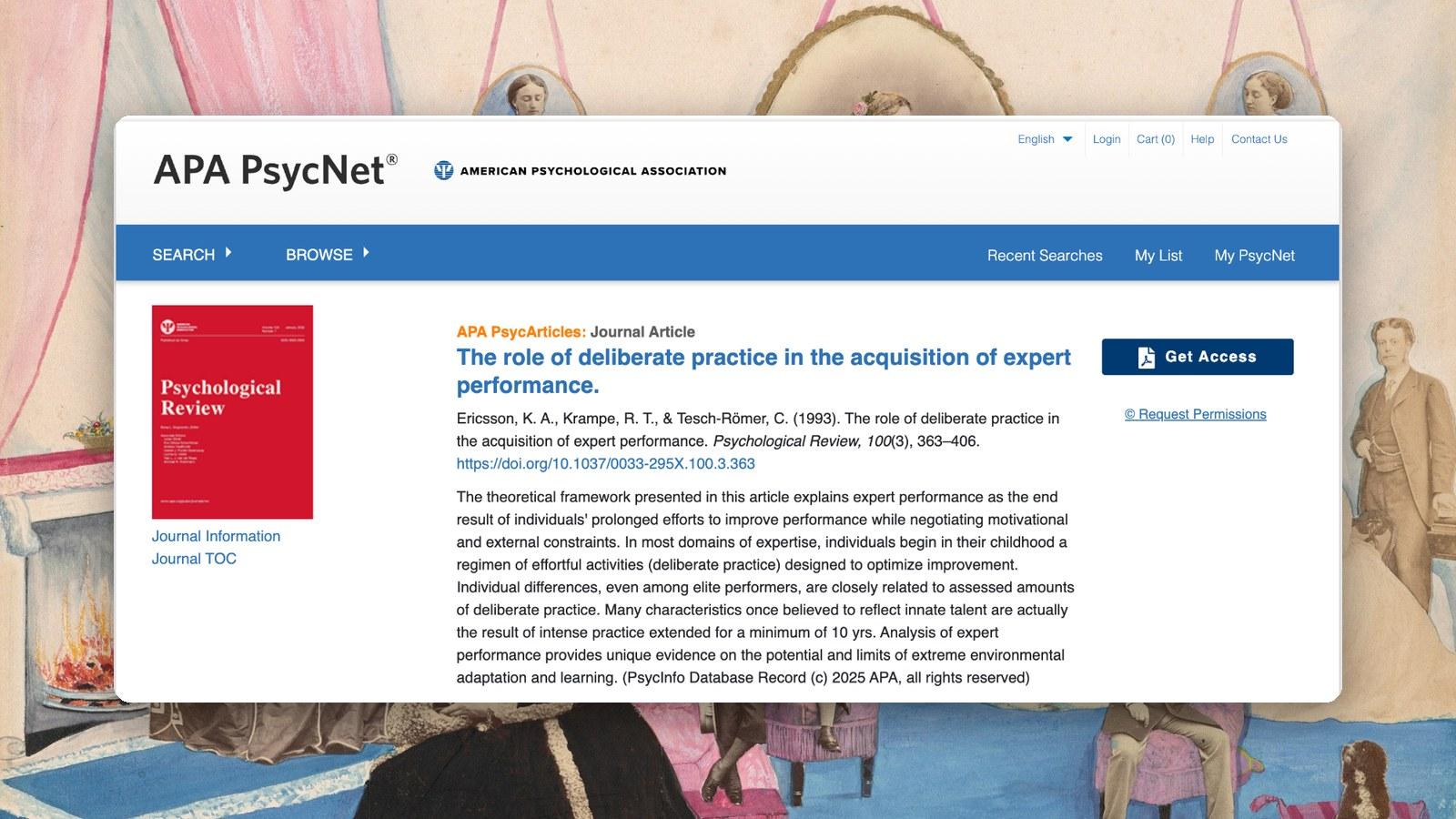
The paper is “The Role of Deliberate Practice in the Acquisition of Expert Performance,” by K. Anders Ericsson, Ralf Th. Krampe and Clemens Tesch-Römer. It was published in Psychological Review, a peer-reviewed journal of the American Psychological Association, in 1993. The research was carried out at the Max Planck Institute for Human Development in Berlin. Read the paper on APA PsycNet
Ericsson was a Swedish-born psychologist and a longtime professor at Florida State University, best known for his research on expertise. He died in 2020. In 2016 he and the science writer Robert Pool wrote that Gladwell had oversimplified the study: 10,000 was an average, not a line every top player crossed, and there was “nothing magical” about the number. Ericsson and Pool in Salon: “Malcolm Gladwell got us wrong”
The study in 60 seconds
- 40 violinists in West Berlin. 30 were students at the city’s music academy, in three groups of 10: the best (nominated by their professors as possible international soloists), the good, and students training to be music teachers.
- The other 10 were middle-aged violinists from two of the city’s top orchestras, the Berlin Philharmonic and the Radio Symphony Orchestra.
- Each person estimated how many hours a week they had practiced alone, for every year since they started playing. Adding those up gives the total hours practiced by each age.
- The students also kept a diary of everything they did, in 15-minute blocks, for one full week: practice, lessons, sleep, leisure.
- A second study did the same with 12 expert pianists and 12 amateurs.
What they found
Hours of practice alone lined up with skill, group by group. The authors tested the totals at age 18, before the academy years, so the course itself could not explain the gap.
| Best | Good | Future teachers | |
|---|---|---|---|
| Total hours by age 18 | 7,410 | 5,301 | 3,420 |
| Hours in the diary week | 24.3 (average of best and good) | 24.3 (average of best and good) | 9.3 |
The orchestra violinists had practiced 7,336 hours by 18, almost the same as the best students. The expert pianists had 7,606 hours by 18, against 1,606 for the amateurs.
The famous number comes from the paper’s chart of hours by age: by 20, the best violinists averaged about 10,000. The text itself speaks of “over 10,000 h of deliberate practice extended over more than a decade” for elite performers. Read the paper on APA PsycNet
Two details surprised us. Practice sessions averaged 80 minutes in every group: the best players did not practice longer at a time, they practiced more often. And the two top groups slept more, 8.6 hours a day against 7.8 for the future teachers, including more afternoon naps.
What the study does not show
- It does not show that 10,000 hours makes anyone an expert. It compares people who were already at different levels. Ten thousand was an average for one group of violinists, not a threshold.
- It does not prove that practice caused the gap. The authors write that, for current practice and current skill, “the direction of causality cannot be determined” from timing alone.
- Most of the hours are memories. Players estimated their practice for each past year from memory. When the estimates for the current week were checked against the diaries, people overestimated their practice, the pianists by about 5 hours a week.
- The groups were small, 10 violinists each, and all musicians at one academy in Berlin.
- Later work found practice matters, but explains less than this paper suggested. A 2014 review of the research across many fields by Brooke Macnamara, David Hambrick and Frederick Oswald found deliberate practice explained about 12% of the differences in performance across fields.
Ericsson disputed parts of that review. Both sides agree practice matters; they disagree on how much. Macnamara, Hambrick and Oswald (2014), Psychological Science
The useful part: short, focused sessions, then rest
The paper’s main point is about the kind of practice, not the count. It defines deliberate practice as effortful work on a task built to improve one thing, with immediate feedback and repetition, and notes that it is “not inherently enjoyable.”
That is why it has limits. The paper reviews training studies that found no benefit beyond about 4 hours a day, and less benefit past 2. The violinists’ own sessions averaged 80 minutes, and they said sleep mattered for getting better. The best players fit more of those sessions into a week, and rested more between them.
This is a study of musicians, so treat it as a strong hint for writing rather than proof. Here is how we would turn it into a routine for a paper. This is our suggestion based on the finding, not something the study tested.
- Work in blocks of about an hour, with your phone away. Pick one part to improve in each block: the thesis, one paragraph’s evidence, or the transitions.
- Get feedback inside the block. Compare your paragraph with a model one, read it aloud, or ask a tutor or classmate one specific question.
- Stop after two or three blocks in a day. Past that, the hours count for less.
- Do more blocks across the week instead of one long night. Then sleep: it was part of the routine of the best players.
How to cite the paper
If you write about practice, talent or learning, cite the paper itself instead of a book or article about the “10,000-hour rule.”
Ericsson, K. A., Krampe, R. T., & Tesch-Römer, C. (1993). The role of deliberate practice in the acquisition of expert performance. Psychological Review, 100(3), 363–406. https://doi.org/10.1037/0033-295X.100.3.363
Ericsson, K. Anders, et al. “The Role of Deliberate Practice in the Acquisition of Expert Performance.” Psychological Review, vol. 100, no. 3, 1993, pp. 363–406, https://doi.org/10.1037/0033-295X.100.3.363.
Further reading
- Ericsson, Krampe and Tesch-Römer (1993), Psychological Review 100(3)
- Ericsson and Pool in Salon: “Malcolm Gladwell got us wrong”
- Macnamara, Hambrick and Oswald (2014), Psychological Science
- Boston Globe: Anders Ericsson, cognitive psychologist and expert on expertise
- Cover background: Mary Georgiana Caroline, Lady Filmer, Lady Filmer in her Drawing Room (Art Institute of Chicago)