 Thezis
Does ChatGPT Make You Dumber? What the MIT Study Actually Found
In June 2025, a team at the MIT Media Lab posted a 216-page paper called “Your Brain on ChatGPT.” Within days it was being shared as proof that AI makes people dumber. The researchers say that is not what they found. We read the paper to set out what it does say, what it does not, and the one habit its results point to for anyone writing essays.
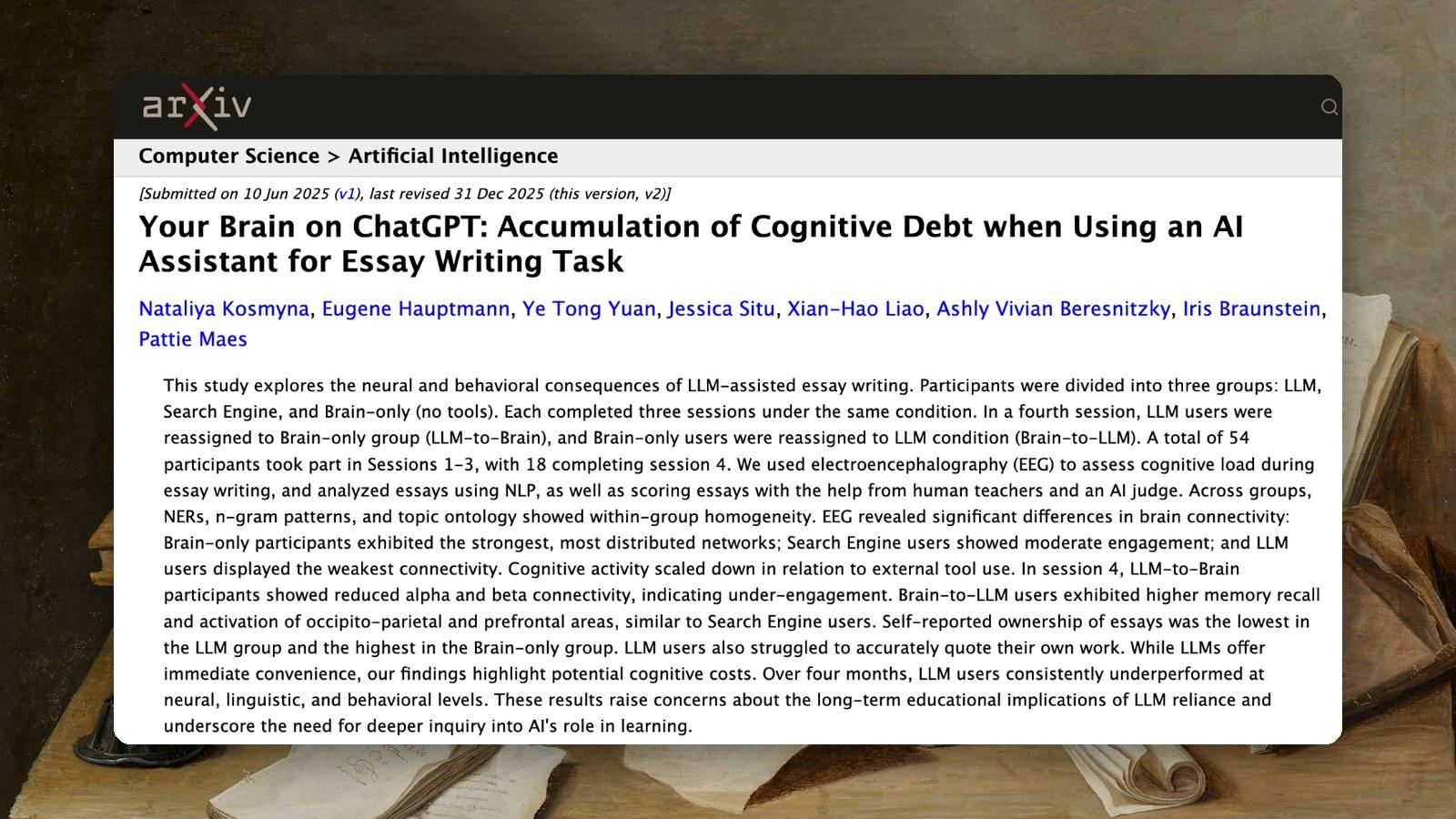
The people behind the study
The study was proposed, designed and run by Nataliya Kosmyna, a research scientist at the MIT Media Lab. Her co-authors are Eugene Hauptmann, Ye Tong Yuan, Jessica Situ, Xian-Hao Liao, Ashly Vivian Beresnitzky, Iris Braunstein and Pattie Maes. Read the paper on arXiv
It is a preprint: it was posted on arXiv and is under review, but it has not been peer-reviewed yet. The team asks readers to treat its conclusions “with caution and as preliminary.” MIT Media Lab project page and FAQ
The study in 60 seconds
- 54 people aged 18 to 39, from five universities in the Boston area: MIT, Wellesley, Harvard, Tufts and Northeastern.
- Three groups of 18. One could use only ChatGPT. One could use any website but no AI, with Google’s AI answers switched off. One used no tools at all.
- Each person wrote three essays, one per session, picking from SAT essay prompts such as “Does true loyalty require unconditional support?” Each essay had a 20-minute limit. The sessions ran over four months.
- A headset recorded brain activity (EEG) while they wrote. After each essay, they were interviewed. Two English teachers and an AI judge scored the essays.
- In a fourth session, 18 people came back and swapped: the ChatGPT group wrote with no tools, and the no-tools group used ChatGPT, on a topic they had written about before.
What they found
The clearest results came from a simple question asked minutes after each essay: can you quote a sentence you just wrote?
| ChatGPT | Search engine | No tools | |
|---|---|---|---|
| Couldn’t quote their own essay | 15 of 18 | 2 of 18 | 2 of 18 |
| Gave a correct quote | 0 of 18 | 15 of 18 | 16 of 18 |
| Said the essay was fully theirs | 9 of 18 | 6 of 18 | 16 of 18 |
| Brain connectivity while writing | Weakest | In between | Strongest |
The more help people had, the less their brain networks were working together while they wrote. The paper calls the risk “cognitive debt”: effort saved in the short term, with long-term costs such as less critical thinking.
The two English teachers who graded the essays were not told which group wrote what. They still picked out essays with near-perfect language and structure but few personal ideas, and called them “soulless.” Their scores rated those essays higher on language and structure, and lower on content and originality. Read the paper on arXiv
What the study does not show
- It does not show that AI makes you dumber. The team’s FAQ asks whether it is safe to say that, and answers “No!” It also asks people not to use words like “dumb” and “brain rot” about the study.
- It is not an intelligence test. EEG shows how brain regions work together during a task. It does not measure IQ or prove a lasting change in the brain, and the authors call for longer studies.
- The group was small and local: 54 people near Boston, and only 18 in the fourth session.
- It tested one tool and one task: ChatGPT, and short timed essays. The authors say the results may not carry over to other AI models or other kinds of work.
- It has not been peer-reviewed yet.
The FAQ, the limitations and the peer-review note are all on the project page. MIT Media Lab project page and FAQ
The useful part: think first, then use AI
The fourth session is where the study gets practical. People who had used ChatGPT for three essays and then wrote without it struggled: 7 of 9 couldn’t quote their essay, and only 1 of 9 quoted it correctly. People who had written on their own first and then got ChatGPT did the opposite: 7 of 9 quoted correctly, and their brain connectivity went up across every band the team measured.
The authors’ own reading is that AI may work better when it comes in “following initial self-driven effort” rather than from the start. They also note that the people who had written alone first asked ChatGPT more questions looking for information, instead of asking it to write.
Only 18 people took part in this session, 9 on each side, so treat it as a strong hint rather than proof.
Here is how we would turn that into a routine for your next essay. This is our suggestion based on the finding, not something the study tested step by step.
- Before you open any AI tool, write your own answer to the prompt: your position and two or three reasons, even if they are rough.
- Write a first draft yourself, even a short one.
- Then use AI the way the second group did: ask it questions, look for more evidence, and check your grammar. Keep the ideas and the argument yours.
- Before you hand it in, try the study’s own test. Quote one sentence from your essay without looking. If you can’t, you probably haven’t made it yours yet.
How to cite the paper
If you write about AI and learning, this paper is worth citing directly instead of a news story about it.
Kosmyna, N., Hauptmann, E., Yuan, Y. T., Situ, J., Liao, X.-H., Beresnitzky, A. V., Braunstein, I., & Maes, P. (2025). Your brain on ChatGPT: Accumulation of cognitive debt when using an AI assistant for essay writing task (arXiv:2506.08872). arXiv. https://doi.org/10.48550/arXiv.2506.08872
Kosmyna, Nataliya, et al. “Your Brain on ChatGPT: Accumulation of Cognitive Debt When Using an AI Assistant for Essay Writing Task.” arXiv, 10 June 2025, https://doi.org/10.48550/arXiv.2506.08872.
The paper was revised on 31 December 2025. If your style guide asks for the version you read, add it.