 Thezis
Active Recall: What the Famous 2006 Study Actually Found
“Active recall is the best way to study” is one of the most shared study tips online. One of the studies behind it was published in 2006 by two psychologists at Washington University in St. Louis, and one of them was still a PhD student. The study did find a big effect, but not right away: 5 minutes after studying, re-reading won. We read the paper to set out what it found, what it does not show, and how to use it.
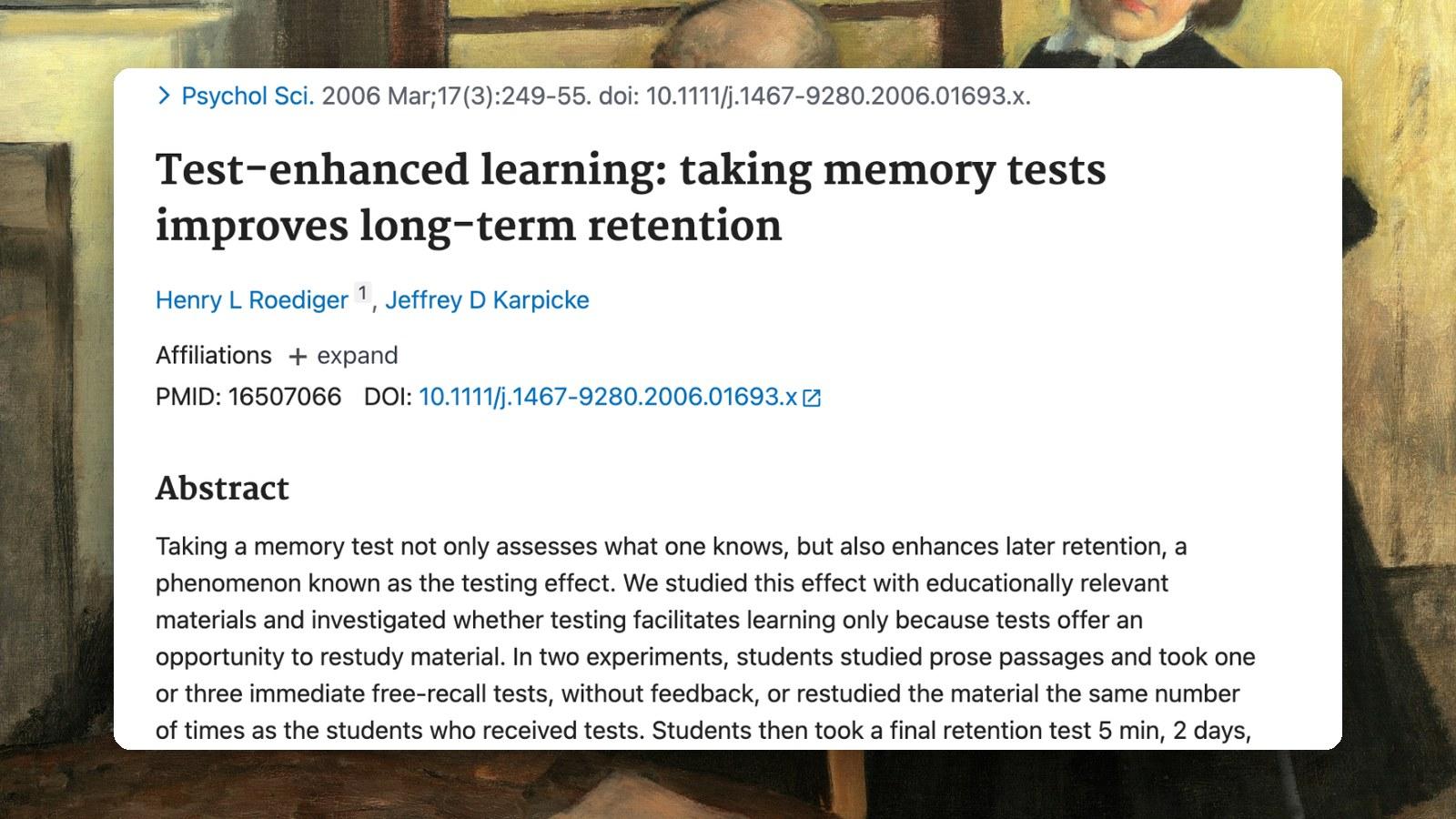
The people behind the study
The paper is “Test-Enhanced Learning: Taking Memory Tests Improves Long-Term Retention,” by Henry L. Roediger III and Jeffrey D. Karpicke of Washington University in St. Louis. It was published in Psychological Science, a peer-reviewed journal of the Association for Psychological Science, in March 2006. Read the paper on PubMed
Karpicke was a PhD student in experimental psychology at Washington University at the time. He finished his PhD in 2007 and moved to Purdue University, where he is now the James V. Bradley Professor of Psychological Sciences and head of the department. Roediger is a memory researcher at Washington University.
The study in 60 seconds
- 300 Washington University undergraduates, aged 18 to 24, took part across 2 experiments, as part of a course requirement.
- The material was two short science passages from a TOEFL practice book, “The Sun” and “Sea Otters,” about 250 to 275 words each. Each was split into 30 “idea units” for scoring.
- Experiment 1 (120 students): read a passage for 7 minutes, then either read it again for 7 minutes or spent 7 minutes writing down everything they could remember. No feedback was given.
- Experiment 2 (180 students, 30 per group): four 5-minute periods. One group read the passage four times. One read it three times and recalled it once. One read it once and recalled it three times.
- Students took a final recall test 5 minutes, 2 days or 1 week later. In Experiment 2 they also rated how well they thought they would remember the passage in a week.
What they found
In both experiments the result flipped with time. Five minutes later, extra reading helped more. Two days or a week later, the students who had practised recalling remembered more.
| Read 4 times | Read 3, recall 1 | Read 1, recall 3 | |
|---|---|---|---|
| Recalled after 5 minutes | 83% | 78% | 71% |
| Recalled after 1 week | 40% | 56% | 61% |
| Times they read the passage | 14.2 | 10.3 | 3.4 |
| Expected to remember | 4.8 | 4.2 | 4.0 |
Experiment 1 showed the same pattern. After 5 minutes, re-reading beat recalling (81% vs. 75%). After 2 days, recalling won (68% vs. 54%), and after a week it still won (56% vs. 42%). The students who recalled remembered as much after a week as the re-readers did after 2 days.
Over the week, the students who only re-read forgot 52% of what they knew at the start. The students who recalled three times forgot 14%. Yet the re-readers were the most confident they would remember. The authors note that students often pick study methods by what feels fast in the short term.
What the study does not show
- It does not show that active recall is “the best way to study” in general. It compared recalling with re-reading, not with other methods such as practice questions, flashcards or spaced study.
- The material was short science passages, and the final test was the same kind of task as the practice: write down what you remember. The authors suggest testing helps “at least in fact-based courses.”
- All participants were undergraduates at one US university, and each group had 30 students in Experiment 2.
- Recalling once and recalling three times were only slightly different after a week (61% vs. 56%), and the paper calls that difference marginal. The big gap was between recalling and only re-reading.
- The authors say the limits of the effect are “not yet known.” They suspect it works best when the test comes soon after learning and students can recall a good part of the material.
The caveats are in the paper’s General Discussion. Read the paper on PubMed
The useful part: read once, then close the book
The most useful number in the paper is the trade-off. The students who read once and recalled three times read the passage only 3.4 times, against 14.2 for the re-readers, and still remembered more a week later (61% vs. 40%). They did it without any feedback on what they had missed.
This comes from 180 students, 30 in each group, with short science passages, so it fits best with fact-heavy reading. Here is how we would turn it into a routine. This is our suggestion based on the finding, not something the study tested step by step.
- Read the section once, carefully.
- Close the book or hide the notes, and write down everything you remember, in any order and in your own words.
- Check what you missed, then do it again later instead of re-reading.
- Don’t trust the feeling that re-reading is working. In the study, the re-readers felt the most sure and remembered the least a week later.
How to cite the paper
If you write about study methods or the testing effect, cite the paper itself instead of an article about active recall.
Roediger, H. L., III, & Karpicke, J. D. (2006). Test-enhanced learning: Taking memory tests improves long-term retention. Psychological Science, 17(3), 249–255. https://doi.org/10.1111/j.1467-9280.2006.01693.x
Roediger, Henry L., III, and Jeffrey D. Karpicke. “Test-Enhanced Learning: Taking Memory Tests Improves Long-Term Retention.” Psychological Science, vol. 17, no. 3, 2006, pp. 249–55, https://doi.org/10.1111/j.1467-9280.2006.01693.x.