 Thezis
The Dunning–Kruger Effect: What the Original Study Actually Found
“Dumb people are too dumb to know they’re dumb” is how the Dunning–Kruger effect usually gets shared, often next to a curve with a peak called “Mount Stupid.” The idea comes from a 1999 paper by two Cornell psychologists, and one of them was still a graduate student. The paper is about skills, not about some people being stupid, and the curve is not in it. We read the paper to set out what it found, what it does not show, and the short lesson that changed the results.
The people behind the study
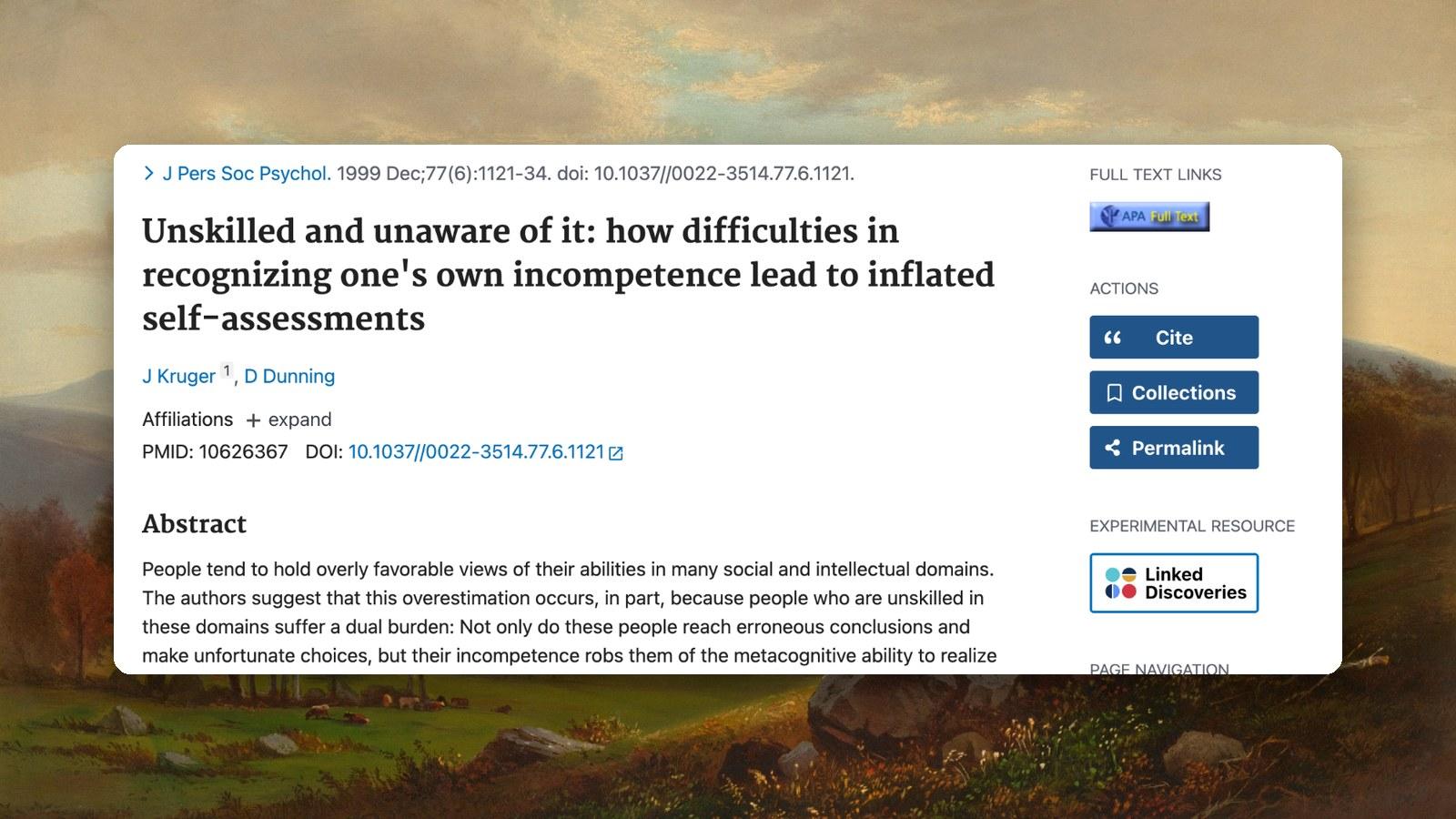
The paper is “Unskilled and Unaware of It: How Difficulties in Recognizing One’s Own Incompetence Lead to Inflated Self-Assessments,” by Justin Kruger and David Dunning of the Department of Psychology at Cornell University. It was published in the Journal of Personality and Social Psychology, a peer-reviewed journal of the American Psychological Association, in December 1999. Read the paper on PubMed
Kruger is the first author. He was a graduate student at Cornell, where he earned his PhD in social psychology in 1999, and by the time the paper came out he had moved to the University of Illinois. He later joined New York University’s Stern School of Business. The paper opens with a true story: a man who robbed two Pittsburgh banks in 1995 without a disguise, because he believed lemon juice on his face would hide him from the cameras. Read the paper on PubMed
The study in 60 seconds
- 334 Cornell undergraduates took part across 4 studies, for extra course credit.
- Study 1 (65 students): rate 30 jokes, scored against ratings from professional comedians.
- Study 2 (45 students): a 20-question logical reasoning test.
- Study 3 (84 students): a 20-question grammar test. The weakest and strongest students came back weeks later to grade five classmates’ tests.
- Study 4 (140 students): a 10-question logic test based on the Wason card task. Half then did a 10-minute logic lesson; the other half did an unrelated task.
- After each test, students guessed how they did: their percentile against classmates and, from Study 2 on, how many questions they got right.
- The authors split everyone into four groups, from the bottom quarter of scores to the top quarter, and compared guesses with real results.
What they found
In every study, the bottom quarter guessed they were above average. Across the four studies they overestimated their rank by about 50 percentile points.
| Study | Real | Guessed |
|---|---|---|
| 1. Humor | 12th | 58th |
| 2. Logic | 12th | 62nd |
| 3. Grammar | 10th | 61st |
| 4. Logic | 13th | 53rd |
The guesses were not wild in every way. Students’ ratings of their ability did rise with their real scores. The weakest students just could not see how far behind they were. In Study 4, the bottom quarter thought they had answered 5.5 of 10 questions right. They had answered 0.3.
The top quarter made the opposite mistake. They knew their own scores well but assumed their classmates had done about as well, so they ranked themselves too low. When they graded other students’ tests in Study 3, they raised their estimates. The bottom quarter did not.
What the study does not show
- It is not about “dumb people.” The authors say they studied skill in specific areas and “make no claim” that the same people would be bad at anything else.
- It has no “Mount Stupid.” The paper’s charts show four groups of students, with guesses rising slowly as real scores rise. A curve with a peak of confidence for beginners does not appear anywhere in it.
- The authors say people are not always unaware. Where the gap is obvious, like playing basketball against a professional or translating a language you do not speak, people tend to rate themselves lower, not higher.
- Lack of skill is not the only reason. The authors list other causes of overconfidence, and note that the other three groups also overrated themselves by about 6 points, which their idea cannot explain.
- All participants were Cornell undergraduates, and the groups were small: 11 to 37 students in the bottom quarter.
- Part of the pattern is a statistical effect. Low scorers have more room to guess too high, and the authors discuss this in the paper. Later researchers argue it explains much of the effect: a 2020 study of 929 adults by Gilles Gignac and Marcin Zajenkowski found the effect for intelligence was much smaller than first reported. Others, including Avram Hiller in 2023, disputed their method. The debate is still open.
The paper’s own answer to the statistical point is Study 4: a statistical effect alone should not change when people learn something. Their guesses did. Gignac and Zajenkowski (2020), Intelligence
The useful part: learn the method, then grade yourself with it
Study 4 is the part worth keeping. After the logic test, 70 students did a 10-minute lesson on how to solve that kind of problem. Then everyone went back through their own test and marked each answer as right or wrong.
The 19 weakest students who had the lesson judged 9.3 of their 10 answers correctly. The 18 weakest students without it judged 3.5. With the lesson, their guess of their own score fell from 5.3 to 1.0 correct, close to the truth, and they ranked themselves at the 32nd percentile instead of the 51st. The weakest students without the lesson did not change.
The authors call this a paradox: the way to help people see their mistakes is to make them better at the skill. This is one logic task with 37 students in the bottom quarter, so treat it as a strong hint rather than a rule. Here is how we would use it on an essay or paper. This is our suggestion based on the finding, not something the study tested.
- Before you judge a draft, learn what good looks like: read the marking rubric, or one strong example of the same kind of paper.
- Turn that into a short checklist: a clear claim, evidence for each point, and a citation for every source.
- Grade your own draft against the checklist, one line at a time, and write down what is missing.
- Then compare your grade with real feedback from a tutor or teacher. If the two are far apart, the checklist needs work, not just the draft.
How to cite the paper
If you write about overconfidence or self-assessment, cite the paper itself instead of an article about the “Dunning–Kruger effect.”
Kruger, J., & Dunning, D. (1999). Unskilled and unaware of it: How difficulties in recognizing one’s own incompetence lead to inflated self-assessments. Journal of Personality and Social Psychology, 77(6), 1121–1134. https://doi.org/10.1037/0022-3514.77.6.1121
Kruger, Justin, and David Dunning. “Unskilled and Unaware of It: How Difficulties in Recognizing One’s Own Incompetence Lead to Inflated Self-Assessments.” Journal of Personality and Social Psychology, vol. 77, no. 6, 1999, pp. 1121–34, https://doi.org/10.1037/0022-3514.77.6.1121.