 Thezis
Are Learning Styles Real? What the Big 2008 Review Actually Found
“Find out if you’re a visual, auditory or hands-on learner, then study that way” is advice many students hear in school. In 2008, four psychologists were asked to check whether the science supports it. Their paper is a review, not a new experiment: they set out what proof would look like, then went looking for it. We read it to set out what they found, what it does not show, and the method they point to instead.
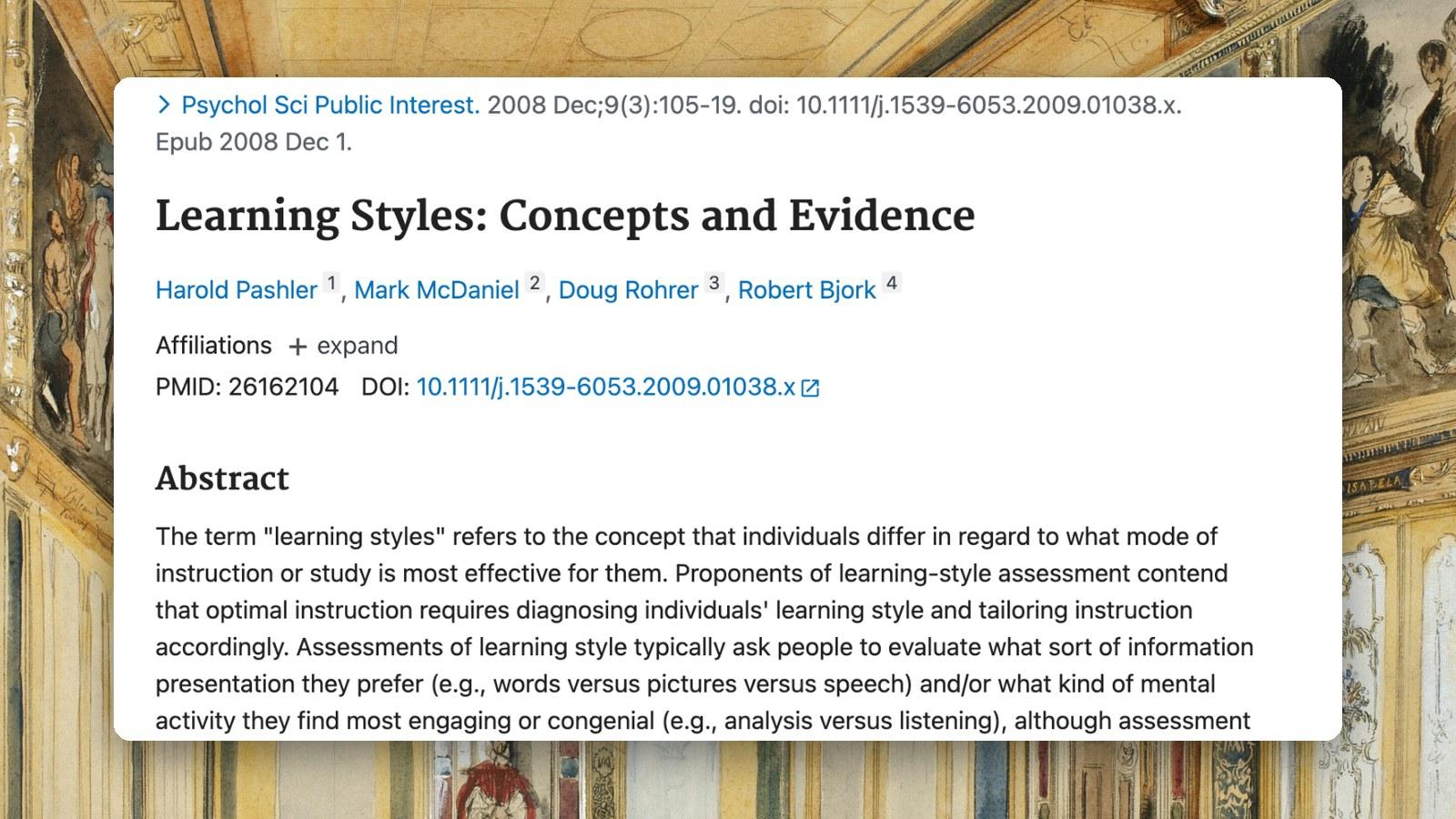
The people behind the review
The paper is “Learning Styles: Concepts and Evidence,” by Harold Pashler of the University of California, San Diego, Mark McDaniel of Washington University in St. Louis, Doug Rohrer of the University of South Florida and Robert Bjork of the University of California, Los Angeles. It was published in Psychological Science in the Public Interest, a peer-reviewed journal of the Association for Psychological Science, in December 2008. Read the paper on PubMed
Pashler is the first author and is a Distinguished Professor of psychology at UC San Diego. The journal commissioned the four of them to judge the evidence for using learning styles in schools. They write that they started with “differing—but not passionately held—opinions” on the idea.
The review in 60 seconds
- It is a review of earlier research, not an experiment. The authors did not test any students themselves.
- They focused on the most popular version of the idea, which they call the “meshing hypothesis”: teaching works best when it matches your style, such as pictures for a “visual learner.”
- First they set out what a fair test needs. Sort students by learning style. Randomly give each group different kinds of teaching. Give everyone the same final test. The best method for one style must be different from the best method for another.
- Then they searched the research for studies that met that standard. The writing on learning styles includes “several thousand articles and dozens of books,” and one earlier review counted 71 different style schemes.
What they found
People do have preferences. Ask them how they like to learn and they will tell you, and their answers are fairly stable. What the authors could not find was good evidence that teaching to those preferences helps people learn more.
Very few studies used a design that could test the idea at all. Of those, they found only one that might support it, a 1999 study of gifted high school students, and they called its evidence “tenuous.” Several well-designed studies found the opposite:
| Study | Who and what | Result |
|---|---|---|
| Massa and Mayer (2006) | College students, a computer electronics lesson with help screens of extra text or diagrams, 3 experiments | No better results when the help screens matched a student’s style, across nearly 20 measures |
| Cook and colleagues (2009) | 123 medical residents, four medicine topics | No support for matching the lessons to their style |
| Constantinidou and Baker (2002) | Adults remembering words shown as pictures, spoken, or both | Pictures helped recall in general, with no link to a “visual” learning style |
Their conclusion: there is “no adequate evidence base” for using learning-style tests in schools, and the time and money would be better spent on methods with strong evidence.
What the review does not show
- It does not prove learning styles are false. The authors say many versions of the idea “have simply not been tested at all,” so it would be an error to call them all disproved.
- It does not say everyone should be taught the same way. The best method can depend on the subject: writing needs a lot of words, and geometry needs diagrams.
- It does not say one student never learns better from one approach than another. The authors accept that this happens. What they doubt is that today’s learning-style tests can predict it.
- It is a review, not a new study. Its conclusions rest on the small number of suitable studies that existed by 2008.
These points are in the paper’s “Points of Clarification” and Summary. Read the paper on PubMed
The useful part: choose the method by the subject, then test yourself
Near the end, the authors point to research that helps every learner instead of one “type.” Their main example is testing: practising recall improves memory, and as far as can be told this “applies to all” learners, whatever they already know. They cite a 2006 study by Henry Roediger and Jeffrey Karpicke for this. They also mention spacing study out over time and mixing different kinds of problems as conditions that help long-term learning.
The review did not test these methods itself. The testing study it cites had 180 students in its second experiment. Here is how we would put it together. This is our suggestion based on the review, not a routine it tested.
- Pick the format that fits the material, not your “type”: diagrams for processes and maps, words for arguments, worked examples for maths.
- After you study a section, close your notes and write down or say what you remember.
- Check what you missed, and come back to it on another day instead of re-reading it all at once.
- Mix different kinds of problems in one session instead of doing all of one kind first.
How to cite the paper
If you write about learning styles, cite the review itself instead of an article about the “learning styles myth.”
Pashler, H., McDaniel, M., Rohrer, D., & Bjork, R. (2008). Learning styles: Concepts and evidence. Psychological Science in the Public Interest, 9(3), 105–119. https://doi.org/10.1111/j.1539-6053.2009.01038.x
Pashler, Harold, et al. “Learning Styles: Concepts and Evidence.” Psychological Science in the Public Interest, vol. 9, no. 3, 2008, pp. 105–19, https://doi.org/10.1111/j.1539-6053.2009.01038.x.